How to Start Meta Ads for a Tea or Food Franchise: A Step-by-Step Guide for India, UAE, UK and Kuwait
A practical Meta ads guide for tea and food franchises: multi-language creative, regional budgets and franchise leads, with real campaign data.
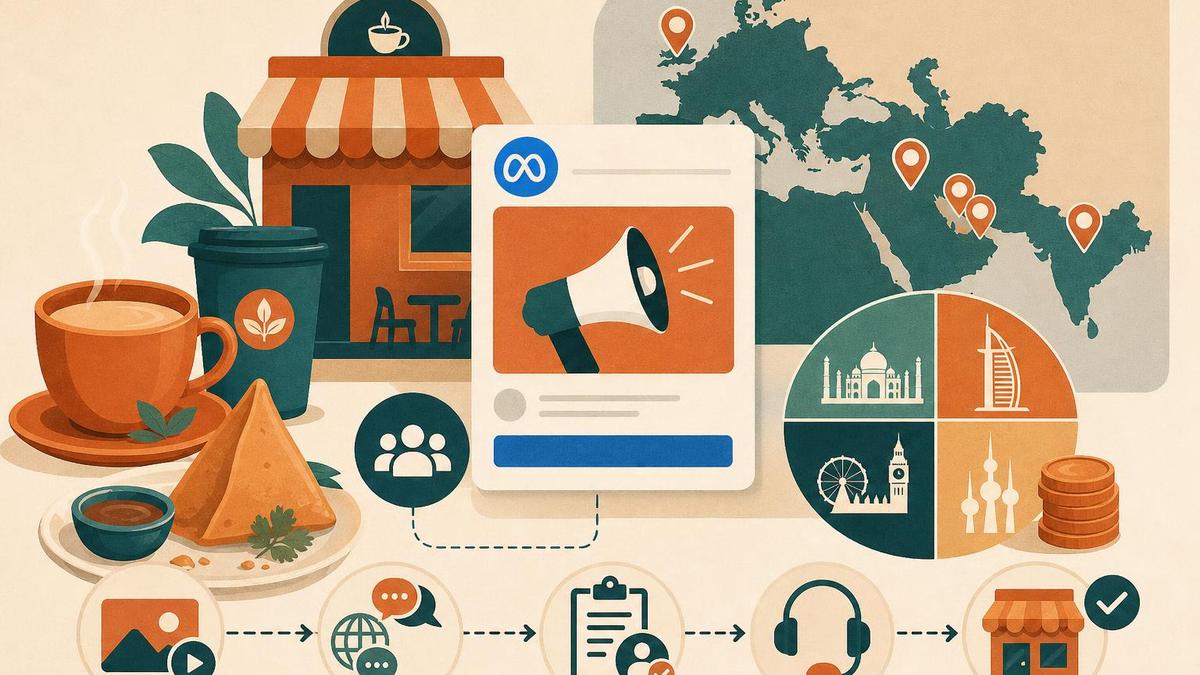
Meta ads for a tea or food franchise are selling a business opportunity, not a cup of chai or a plate of food, to someone with savings to invest and a decision that will take weeks rather than minutes. Running the same campaign you would use to sell a food order wastes money on people who were never going to invest in a unit. This guide covers how to run Meta ads to recruit franchise partners for a tea or food brand in India, the UAE, the UK and Kuwait, drawing on a real multi-region campaign rather than general theory. If you are advertising to get customers rather than franchisees, our guide to Meta ads for a cloud kitchen covers that side separately.
What is actually different about advertising for franchise partners instead of customers?
A franchise ad has to convince someone to commit capital and months of their time, not just try a product once. The enquiry that matters is someone who can fund a unit and wants to operate it, not someone who liked the photo of the tea.
A customer ad can run on impulse: a ten-second glance and a tap to order. A franchise ad behaves more like a business-to-business lead generation campaign. It needs the unit economics stated plainly, a real sense of what the brand looks like on the ground, and a form that asks enough questions to separate someone who can actually fund a unit from someone who is only curious. Our complete guide to Meta ads lead generation covers the qualification principles that apply here too.
Why does a single campaign waste money across regions and languages?
A franchise brand that runs one English-language campaign across several states or cities pays to reach people in languages and markets where the creative does not land, which pushes the cost of every enquiry up and the quality of those enquiries down.
This is the exact problem a tea franchise client on this site, Patidar Rajwadi Chai, had before splitting its campaigns. A single English campaign was being pushed across very different regions, so cost per enquiry varied wildly between them. Separating the account into distinct Gujarati, Hindi and English campaigns, each with its own native-language creative, and giving each region its own budget rather than one shared pool, brought in a 4.8x return on ₹2.3L of spend, with franchise enquiries arriving consistently across regions rather than being concentrated in whichever one the English creative happened to suit. Region-level budget control meant a strong-performing market was never subsidising a weak one.
What creative actually produces a funded buyer rather than a browser?
Creative that states the investment size, the format and the unit economics up front filters out people who are only browsing, because someone without the capital or interest will simply scroll past rather than fill in a form they cannot follow through on.
A related case on this site makes the same point from the cloud kitchen side. ARC Super Kitchens used short video reels that explained the unit economics directly to camera, rather than leaning on appetising food shots alone, to filter for serious operators instead of people who just liked the visuals. That campaign returned 5.1x on ₹72K of spend, with a noticeably better quality of enquiry reaching the sales team than generic food creative had produced. For a tea or food franchise, the same principle holds: show the kiosk or counter format honestly, state the investment range in the ad copy itself, and let the offer do the filtering before the form does. For creative testing cadence and formats more broadly, see our guide to Meta ads creative.
How should budget be split across India, UAE, UK and Kuwait?
Budget should be set and judged per market rather than pooled, because the cost of reaching someone, the going rate for a franchise investment, and the competitive set of other opportunities being advertised all differ by country.
The India case study above is the clearest proof point on this site for language and region separation within one country. The same logic carries into a brand expanding from India into the UAE, UK or Kuwait: each market gets its own ad sets, its own currency-appropriate investment figures in the copy, and its own budget line, so a market with no existing brand recognition is not expected to perform on the same budget as one where the brand is already known. Do not expect identical cost per enquiry across all four markets. Treat each one as its own test.
How do you separate a funded franchise buyer from someone just curious?
A short qualification step before a human call, asking about available capital, preferred city or region, and timeline, sorts realistic buyers from people filling in a form out of idle interest, without costing the business a sales call on every single enquiry.
The same cloud kitchen franchise shows the same lesson on the follow-up side, through a separate WhatsApp automation project rather than the ad account itself. The brand had 785 franchise enquiries that had been collected over months and left untouched, assumed dead by the team. A qualification flow run over WhatsApp, asking about funding and format before anything else, revived that list into 42 franchise signups, a 5.35% conversion rate, with no new ad spend at all. An enquiry nobody called back within the first week is not automatically a wasted one. For the mechanics of building that kind of recovery flow, see our WhatsApp automation tool guide.
What should happen between the Meta enquiry and the franchise sales call?
The enquiry should move straight into an instant acknowledgement, ideally on WhatsApp, followed by the qualification questions, rather than sitting in an ads manager inbox until someone happens to check it.
Franchise decisions move slower than a food order, but a slow reply is still a real disadvantage. A prospective franchisee comparing several brands at once will often enquire with more than one, and the first brand to reply with a clear, specific answer, rather than a generic acknowledgement, has an edge that has nothing to do with the franchise opportunity itself.
Does a franchise campaign need different measurement to a direct-to-consumer one?
Yes. A franchise sales cycle runs for weeks or months from first enquiry to signed agreement, so judging the campaign purely on Meta's in-platform cost per result within the first fortnight will usually make it look worse than it is.
Track enquiries through to signed agreements in a CRM or even a shared spreadsheet, tagged by which campaign and region they came from, and judge the campaign against that longer number rather than Meta's own reporting window. A campaign that looks expensive after two weeks of in-platform data can still be the cheapest route to a signed franchisee once the full cycle is counted.
Does a tea or food franchise need a dedicated landing page before running Meta ads? Not at the start. A lead form inside Meta, asking for city, available capital and preferred format, is usually enough to begin testing. A dedicated page is worth building once the campaign is consistently producing enquiries worth the design time.
Should franchise recruitment ads run on the same ad account as outlet-level ordering ads? They can share an account, but never a campaign. Franchise enquiries and food orders are different actions with completely different value to the business, and blending them into one campaign confuses Meta's delivery system and makes it impossible to judge either one properly.
How long does it typically take to see a qualified franchise enquiry? Treat the first one to two weeks as Meta's delivery system still settling, not a verdict on the campaign. Wait for a proper batch of enquiries, generally 20 to 30, before judging whether the targeting, creative and investment framing are working.
Can a single-language campaign work if the franchise only operates in one state or city? Yes, if that state or city is genuinely single-language in practice. The lesson from splitting by language is about matching the campaign to how the audience actually communicates, not about always needing three or more languages regardless of footprint.
Is it worth retargeting people who downloaded a franchise brochure but did not enquire further? Yes, in a separate, smaller campaign. Someone who downloaded a brochure has already shown more interest than a cold audience, and a short retargeting sequence with a direct call to action, rather than the same broad creative, is usually a cheap source of a second look.
Does Instagram or Facebook placement matter more for franchise recruitment ads? It depends on the age and profile of the typical investor in that market, which is worth testing rather than assuming. Automatic placements across both, with performance reviewed by placement after a proper batch of results, usually settles the question faster than guessing upfront.
Frequently Asked Questions
Related articles
Book a free 30-minute strategy call. I'll show you exactly where your ads or automation are leaking money.
Book Your Strategy Call →