How to Get Customers for a Cloud Kitchen with Meta Ads: A Step-by-Step Guide for India, UAE, UK and Kuwait
A practical Meta ads guide for cloud kitchens in India, the UAE, the UK and Kuwait: aggregator reliance, creative, budget and WhatsApp follow-up.
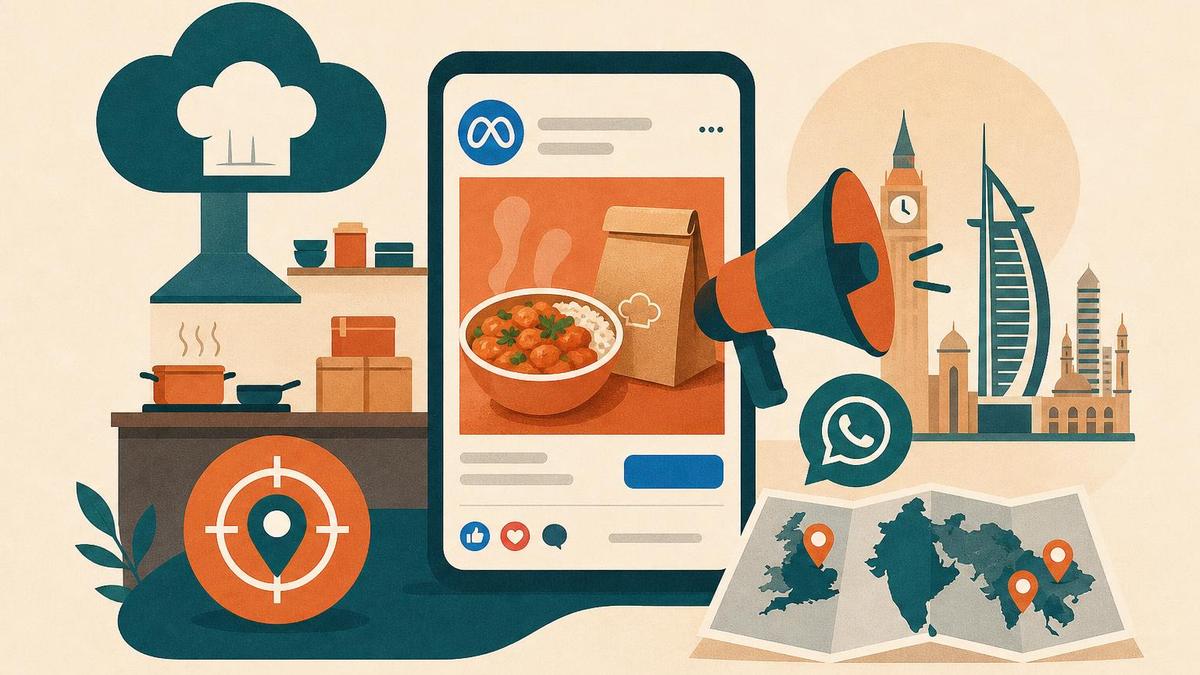
A cloud kitchen has no dining room, no passing footfall and no signage to catch anyone walking past. Every single customer arrives through a screen, whether that is an aggregator app (Zomato or Swiggy in India, Talabat, Deliveroo or Careem in the UAE and Kuwait, Deliveroo, Uber Eats or Just Eat in the UK) or a Meta ad. This guide covers how a cloud kitchen in India, the UAE, the UK and Kuwait can use Meta ads to get noticed off the aggregator apps, and the separate question of using Meta ads to recruit new operators into a cloud kitchen franchise.
What makes a cloud kitchen different from a restaurant when it comes to Meta ads?
A dine-in restaurant can win a diner who was already walking past and glanced at the menu in the window. A cloud kitchen has no shopfront, so the ad has to do the whole job of getting someone to open an aggregator app or message you directly, rather than just reminding a passer-by that you exist.
That changes what the ad needs to prove. A restaurant ad can lean on atmosphere and the room filling up at dinner service. A cloud kitchen ad has to prove the food is worth ordering sight unseen, and often has to prove the kitchen itself is clean and real, since there is no shopfront doing that reassurance for you. If you also run a dine-in outlet alongside the delivery brand, our guide to Meta ads for a restaurant covers the walk-in side separately.
Should a cloud kitchen even run Meta ads, or are the delivery aggregator apps enough on their own?
Relying only on in-app aggregator ads puts a cloud kitchen in a bidding war against every other kitchen on the same app, for a customer the platform owns, since it can show that same customer a competitor's listing a minute later. Meta ads build an audience and a direct ordering channel the aggregator cannot touch or take a commission on.
The two are not a straight substitute for each other. Aggregator ads reach someone already hungry and already browsing that app, which is a useful but narrow moment. Meta ads can reach someone earlier, build recall for the brand name before the next time they are hungry, and point people toward a direct WhatsApp or phone order that skips the aggregator's commission entirely. Most cloud kitchens that grow past one or two locations end up running both rather than choosing one.
What budget does a cloud kitchen need to test Meta ads?
There is no case study on this site for a cloud kitchen selling meals directly through Meta ads, so treat any cost-per-order figure quoted elsewhere as unverified. Plan a test budget large enough to produce a readable batch of enquiries or orders, generally 20 to 30, before judging whether the targeting and offer are working.
The only cloud kitchen case study on this site, ARC Super Kitchens, used Meta ads to recruit franchise operators rather than to sell meals to diners: short videos explaining the unit economics, aimed at people considering buying into the brand, returned 5.1x on ₹72K of ad spend. That is a franchise-recruitment result, not a benchmark for getting someone to order a meal, so treat it as a pattern worth copying (proof-led video outperforms a generic food photo) rather than a number to bank on.
Which Meta ad objective fits a cloud kitchen: traffic, leads or conversions?
For direct orders, use the Conversions objective if you can track an order event on your own ordering page or WhatsApp catalogue, or a Messages objective if ordering happens entirely through chat. A plain Traffic objective sends clicks to a menu page with no way to tell whether anyone ordered.
For franchise or operator recruitment, a Leads or Messages objective suits better than Conversions, since the goal is a qualified conversation rather than a tracked purchase event. The complete Meta ads guide covers how objectives map to campaign structure if you are setting up an account for the first time.
What ad creative gets a cloud kitchen noticed in the feed?
Short vertical video of real food being plated or packed usually outperforms a still photo, because it proves the food exists and shows portion size and packaging, three things a diner cannot check for themselves before ordering from a brand with no visible kitchen. A quick, honest glimpse of the kitchen itself builds trust that a shopfront would otherwise provide for free.
Keep it close to what arrives at the door. Over-styled, studio-lit food photography can look impressive and still cost you the order if the packaged reality looks different, because a disappointed first order rarely becomes a second one. For the mechanics of testing video against static formats, see our guide to Meta ads creative.
How should a cloud kitchen target its Meta ads without wasting spend outside its delivery radius?
Set the radius to the zone you can deliver to, whether that is your own riders or the radius an aggregator partner covers, and nothing wider. An ad that reaches someone three suburbs outside your delivery zone has wasted its impression the moment it was served, regardless of how good the creative is.
Dayparting matters here in the same way it does for a restaurant: weighting spend toward the hour or two before lunch and dinner reaches people while they are deciding what to order, rather than spreading the same budget evenly across a day when most of it lands on someone who already ate.
Can Meta ads help a cloud kitchen brand recruit franchise operators, not just diners?
Yes. It is a different campaign with a different audience entirely from the one aimed at diners, so treat it separately from the start. The table below separates the two so the offer, creative and objective are not mixed into one confused campaign.
| Selling meals to diners | Recruiting franchise operators | |
|---|---|---|
| Audience | People in the delivery radius who order food | People with capital considering a food business |
| Offer | A dish, a combo or a first-order discount | A franchise model, unit economics and support |
| Creative | Food being plated or packed, honest and quick | Video explaining margins and what running a unit involves |
| Objective | Conversions or Messages | Leads or Messages |
Patidar Rajwadi Chai, a tea franchise rather than a cloud kitchen, is the other food and beverage franchise case study on this site: separate Gujarati, Hindi and English campaigns for franchise enquiries returned 4.8x on ₹2.3L of ad spend. Like the ARC Super Kitchens figure, that is a franchise-recruitment result rather than a direct-order one, but it shows the same lesson applies across cuisines: splitting by language and region beats one generic campaign once you are recruiting across markets.
How does WhatsApp fit into a cloud kitchen's Meta ads funnel?
A click-to-WhatsApp ad can take an order enquiry straight into a chat that shares the menu, confirms the order and sends a delivery update, which suits a brand that does not want to build a full ordering page yet. It also gives you a direct channel to the customer that the aggregator apps do not hand over.
That same channel is useful after the first order, not just during it. A short WhatsApp nudge a week or two after someone's first order, asking if they would like to reorder a dish they liked, costs nothing in ad spend and works on people who already know the food is good. Our guide to lead generation covers qualifying and following up on enquiries in more depth, and our WhatsApp automation guide covers building a flow like this properly.
Frequently Asked Questions
Related articles
Book a free 30-minute strategy call. I'll show you exactly where your ads or automation are leaking money.
Book Your Strategy Call →